New clients! For a limited time, Get 13 Classes for $78 (only $6 per class)

The Method
Transverse Abdominis Workout to Target Your Deepest Core Muscles
February 24, 2026

Have you ever done core work and noticed a dome-like appearance in your abs? Or had trouble maintaining stability? It could be a sign of weak transverse abdominis muscles, a common — but potentially troublesome — muscle imbalance. Enter: our transverse abdominis workout.
There are many ways to strengthen your transverse abdominis muscles, but barre is highly effective thanks to its focus on core engagement, proper alignment, breathwork, and steady control. Let’s talk about what the transverse abdominis muscle is, why it’s important, and how transverse abdominis workouts can help you build strength that supports not only your core, but your whole body.
What is the transverse abdominis muscle?
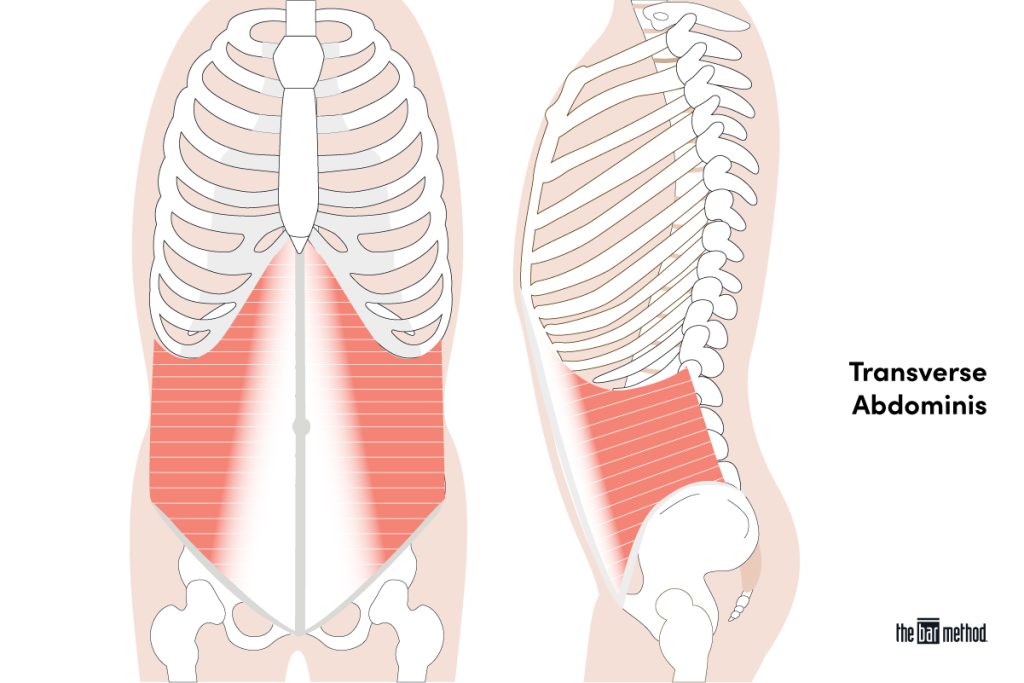
The transverse abdominis (also known as the transversus abdominis, TA muscle, TVA muscle, or transverse abs) is the deepest muscle in your core. Known as the “corset muscle,” the TA protects and stabilizes your core and spine, as well as your rectus abdominis muscles (the “six pack”). It’s also critical for preventing diastasis recti (abdominal muscle separation) during pregnancy, providing extra support as the baby grows. In short, the TA muscle has several important jobs!
Related: Barre During Pregnancy: Why It’s a Safe and Effective Workout
Why does activating your TVA muscle matter?
The core is involved in every movement that you do, so the transverse abdominis provides the foundation for total strength — starting with your core.
Keeping your TA muscle engaged during barre class doesn’t just develop deep core stability and protect the spine during small, controlled movements. It also enhances your precision, improves posture, prevents injury, and supports breath control and endurance so you get the most out of every movement in class. The result: a flatter, tighter core, and better stability in and out of the studio.
What are the signs of weak transverse abs?
A weak transverse abdominis often shows in different ways, including:
- Poor core control and posture
- Low back discomfort during barre exercises like plank or foldover
- Visible abdominal doming during curl work
- Difficulty maintaining balance in moves like thigh work and seat work
- Persistent lower belly pooch
- Overuse of the back and hip flexors during everyday activities like walking and lifting (which can lead to strain and injury)
Fortunately, transverse abdominis exercises can help improve stability, posture, and your overall movement efficiency.
How to activate your transverse abdominis muscles during barre class
To activate your transverse abdominis (TA) during core work, exhale and gently draw your belly button toward your spine while lifting through your pelvic floor, as if you’re zipping up a tight pair of pants. Focus on wrapping your core like a corset without holding your breath or overly tensing. This deep, subtle engagement creates stability and supports posture throughout movements in class.
Some other cues your instructor may give in class to help you activate your transverse abs include:
- “Scoop your abs or pull in your abdominals.”
- “Draw your belly button toward your spine.”
- “Gently press your low back into the floor while drawing in your abs.”
- “Tilt your pelvis or tuck slightly to deepen ab engagement.”
- “Think about how your abs contract when you cough, sneeze, or laugh.”
Transverse abdominis workout: 5 barre exercises for abs
Through a series of isometric ab exercises, curl work, and other movements that engage the deepest muscles in your core, our Method helps you build strength that supports your whole body. Here’s a preview of five barre exercises for abs you might try in class, hand-picked by our team of expert instructors.
1. Static curl
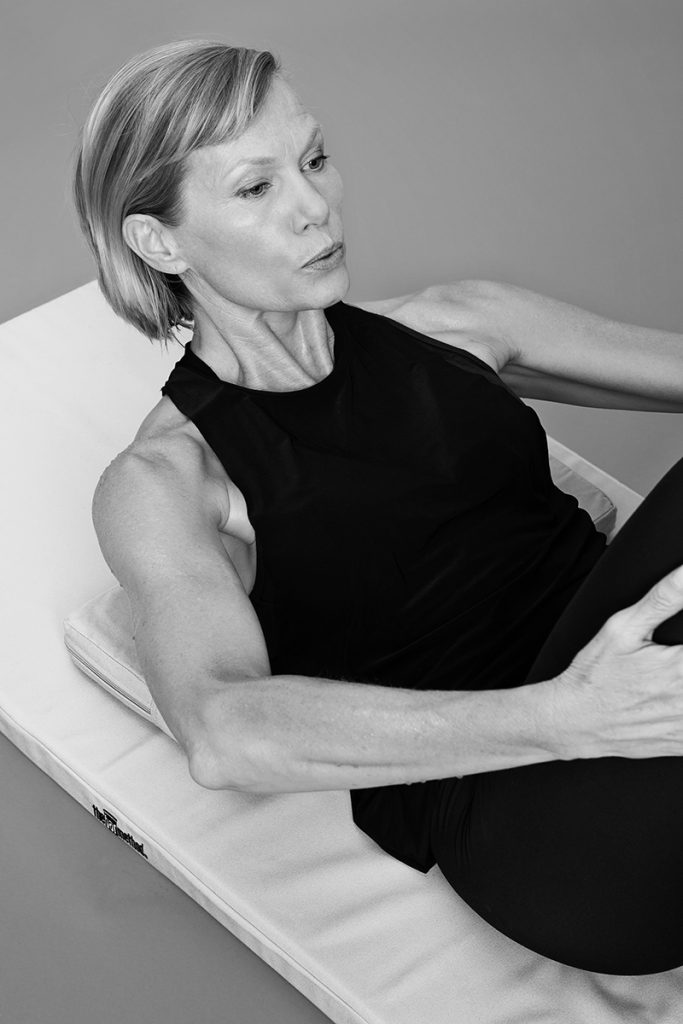
How to:
- Sit on the floor with your legs bent and feet flat on the floor.
- Start on your elbows, grip your glutes, and pull your abs down toward your spine.
- Hold onto the backs of your thighs and bend your elbows to the side to engage your biceps.
- Exhale deliberately at different tempos to engage your TVA muscle.
- Perform this exercise for up to two minutes.
Note: If you feel tension in your neck or can’t hold this position, place a support at your midback to help you maintain a forward bend at your waist with relaxed shoulders.
For more challenge: Let go of your legs and float your arms by your sides as you breathe for 10 to 20 counts. Reset as needed by holding your thighs again.
2. Forearm plank

How to:
- Lie on your stomach on the floor.
- Place your forearms on the floor with your elbows stacked below your shoulders and palms facing inward.
- Draw your legs to hip-width apart and lift your hips to align with the front of your ribcage (higher than you think you might need to!).
- Grip your glutes and tuck under.
- Exhale sharply and draw your abdominal muscles tighter with each breath.
- Hold for 60 to 90 seconds.
For more challenge: Plank on the balls of your feet instead of your knees to increase core engagement.
3. Floor zinger
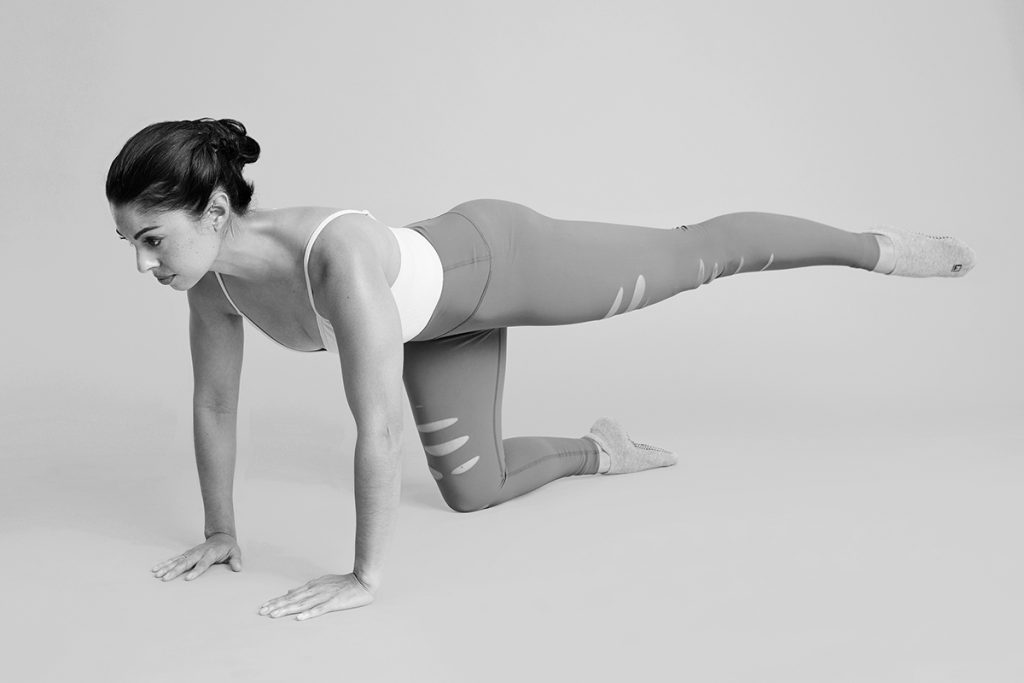
How to:
- Come down to your hands and knees.
- Raise one leg up in line with your lower back to feel your glutes engage.
- Lift your leg at varying tempos.
- Exhale and pull your abs in every time you lift your leg.
- Perform for up to one minute. Repeat on the other leg.
- Kneel down and extend one leg forward to stretch your glutes and hamstrings afterward.
For more challenge: Extend your opposite arm forward in a balance as you lift your leg.
4. Flatback curl (with heel taps)
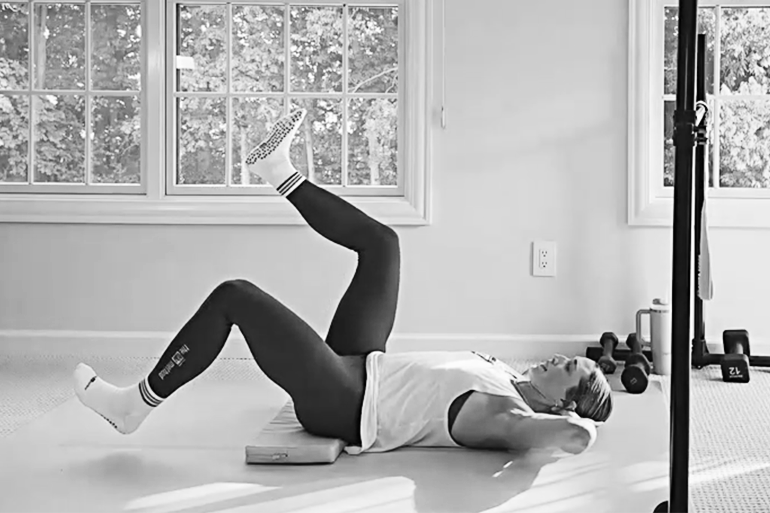
How to:
- Lie down and place a small mat under your glutes.
- Extend your legs over your hips and keep them hip-width apart. Bend your knees to 90 degrees and flex your feet.
- Pull your abs in to secure your lower back and create a pelvic tilt.
- Place your arms in a low “V” shape by your hips and push down into the floor for leverage.
- Slowly lower each leg a few inches forward, then slowly raise it back over your hip. Tip your thigh forward rather than straightening your knee.
- Keep your hips slightly tilted upward to maintain abdominal engagement and breathe deeply throughout.
- Perform up to three sets of 10 to 20 reps.
For more challenge: Increase the range of motion in your legs, making sure you can maintain ab engagement and keep your low back pressed down to avoid arching.
5. Flatback curl (tabletop variation)
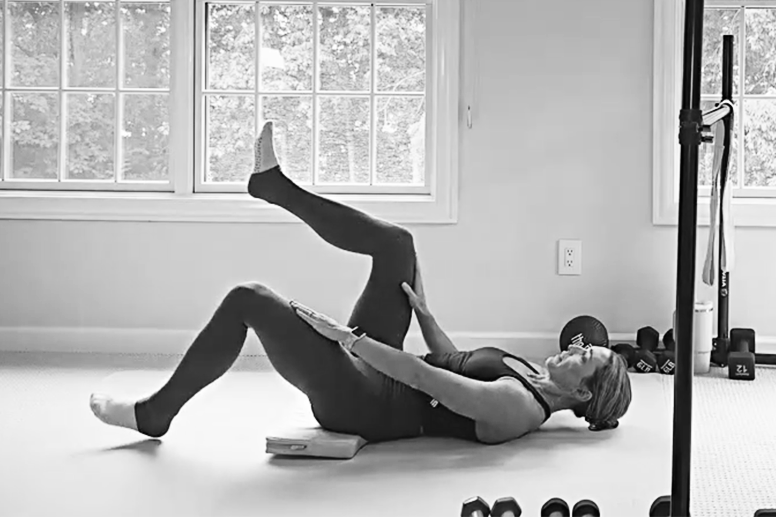
How to:
- Set up the same way you would for flatback curl with heel taps. This time, you’ll engage your arms as well.
- Keep your head down and press your hands into your thighs.
- As you lower one leg, reach your same-side arm overhead as far as is comfortable for your shoulder, then return to the starting position.
- Alternate sides as you focus on your breath and pelvic tilt.
- Perform up to three sets of 10 to 20 reps.
Bonus transverse abdominis exercise: The string vacuum exercise
You may have heard that the string vacuum (or stomach vacuum) exercise is a great way to tap into your TA muscles — but what is it? While this move isn’t part of our signature Method, the breathing techniques and cues utilized in this exercise are woven into our classes. So, let’s talk about it!
The string vacuum exercise is a deep core technique that targets the transverse abdominis muscle by drawing the belly button inward toward the spine while exhaling fully. It involves pulling the lower abdomen in and up without holding the breath, creating a gentle “sucking in” sensation that strengthens the deep core muscles and improves posture and abdominal control.
It can be done in any position (e.g., standing, sitting, lying down, or in quadruped). The more you practice the exercise, the easier it becomes to activate the TA in exercises and everyday movements.
Common mistakes to avoid during transverse abdominis exercises
Engaging the transverse abdominis muscle doesn’t always come naturally. If you experience visible abdominal doming (or your core has the appearance of a bread loaf) during core work, it could be a sign that you’re making one of these common mistakes:
- Sucking in your stomach or overusing surface abdominal muscles like the rectus abdominis
- Over-tucking your pelvis
- Clenching other areas of your body (glutes, thighs, jaw) or flaring/lifting the ribs
- Holding your breath
- Losing engagement or activation during movements
- Neglecting to engage the pelvic floor
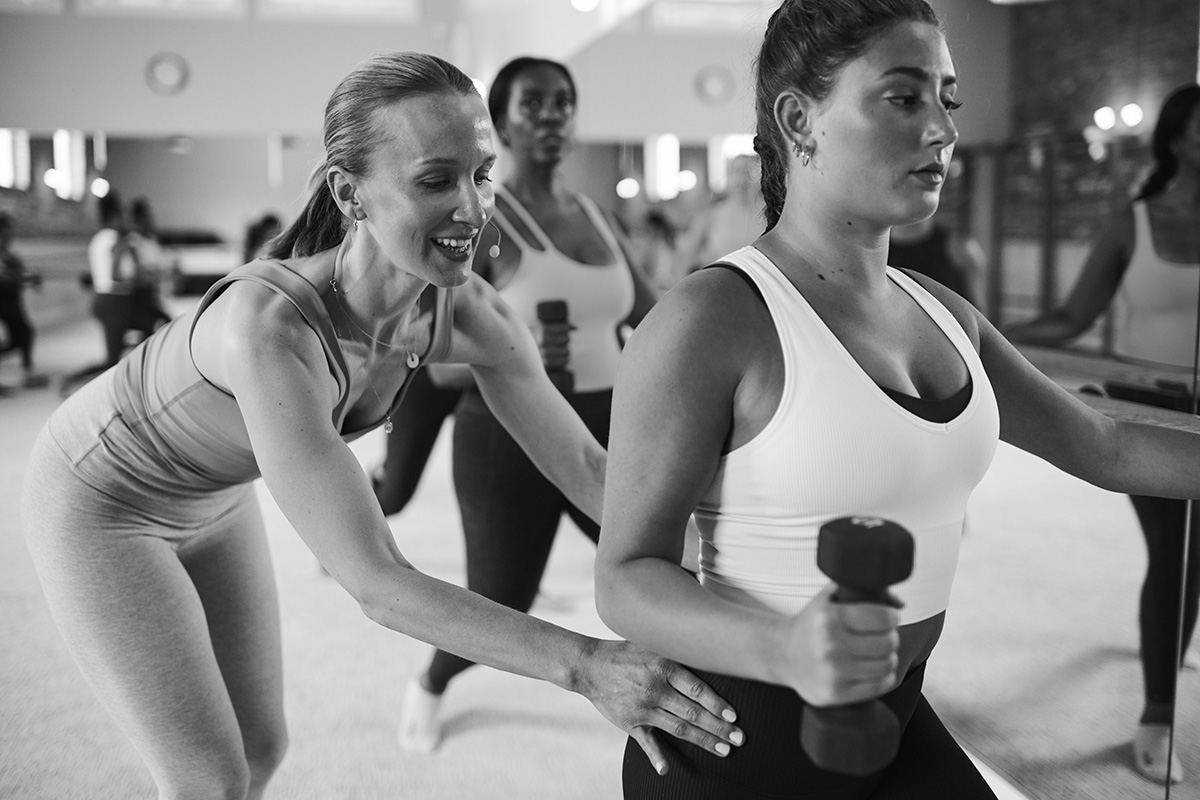
If you’re unsure whether you’re activating your TA properly, ask your Bar Method instructor! During class, your instructor will provide cues and make adjustments to help you refine your form for maximal benefits and keep you on track.
How to achieve better core engagement during barre
Whether you’re in barre class or doing a transverse abs workout, use the tips below as you perform transverse abdominis exercises. These guidelines can help you effectively engage your TA muscles and achieve better results.
- Coordinate your breath with your movement. Breath is a core element of every barre class. Exhale during the most challenging part of each exercise and inhale as you recover.
- Stay firm, but relaxed. If you’re straining, you may be adding unnecessary tension to your core.
- Maintain a neutral spine and engage your pelvic floor. Visualize your core as a 360-degree cylinder throughout movements. Engaging your pelvic floor and keeping a neutral spine will distribute force evenly through your core and help prevent injury.
Looking for a transverse abs workout? Head to the barre!
Barre is designed to strengthen your entire body, and that includes your deepest muscles like the transverse abdominis. Whether you have weak TA muscles or you’re simply looking to increase your strength, properly engaging your core during barre can support you through every movement to boost your overall stability and balance. Our team of barre experts is here to ensure that, hand-picking every exercise in our Method and offering form adjustments along the way to help you build all-over strength — starting with your core.
More tips to build your strongest self
- The Best Barre Core Exercises to Tone Your Stomach
- Not Seeing Results? How Fitness and Nutrition Support Your Wellness Goals
- Why Do Gyms Have Mirrors? The Science Behind Working Out in Front of a Mirror