New clients! For a limited time, Get 13 Classes for $78 (only $6 per class)

The Method
Guide to Postnatal Core Exercises: Regain Strength With Barre
August 4, 2026
“It’s a marathon, not a sprint,” the adage goes. Clichéd as it may seem, it accurately describes the feeling of getting back into exercise postpartum. After having a baby, returning to movement requires mindfulness and intention.
This moment is for shifting the focus from building maximal strength to regaining functional strength, stability, and endurance — especially in the core, pelvic floor, and postural muscles. Recovery, joint safety, and injury prevention become higher priorities, while still maintaining total-body conditioning.
Barre can be a low-impact and effective option for this phase — a time for recovery and rebuilding vthrough postnatal core exercise.
In this article, we’ll cover:
- Why postnatal core exercises are different from standard abdominal work
- How barre addresses postpartum concerns like diastasis recti, deep abdominal strength, and pelvic floor recovery
- What makes barre a safe and effective choice for postnatal exercise
- Postnatal core exercises for rebuilding strength
- How to progress safely over time without pushing too hard
Why postnatal core exercises are different
Everyone’s pregnancy and labor journey is unique. No matter how complicated, or if you gave birth vaginally or via Cesarean section, your core went through a transformation.
Postnatal core exercises go beyond standard crunches. They are workouts designed to strengthen the deep abdominal muscles and pelvic floor after childbirth. Here’s what that means for three key areas of postpartum recovery.
Rebuilding deep abdominal strength helps correct diastasis recti
For most pregnant women, some degree of diastasis recti — where the abdominals separate as the body expands to accommodate a growing baby — is natural and unavoidable. Recovery starts in the deepest layer: the transverse abdominis, which acts like a natural corset to support the spine, pelvic floor, and overall stability.
Barre supports this by focusing on safe, controlled core engagement that strengthens the transverse abdominis without overstressing the linea alba — the thin band of connective tissue that runs between the left and right sides of your abdominals.
Through focused deep core exercises and breathwork, you can activate and sustain this deep core layer to support functional movement and promote a safer postpartum recovery.
Core exercises support pelvic floor strength recovery
Postnatal core exercises through barre strengthen the pelvic floor by targeting the deep stabilizing muscles of the core through breath work and controlled, precise movements that engage the abs, glutes, and deep hip/pelvic muscles simultaneously.
Barre exercises often focus on small isometric movements that encourage subtle pelvic floor activation while maintaining proper alignment and breath control. Over time, this improves pelvic stability, endurance, and coordination, which can support bladder control, posture, and overall core strength — benefits that are especially valuable during pregnancy, postpartum recovery, and everyday movement.
Low-impact movements make barre a smart choice for postnatal recovery
Barre is an effective and safe option for postnatal workouts because it combines low-impact, controlled movements with a focus on core engagement, alignment and muscle stabilization, which are essential for rebuilding strength safely after pregnancy.
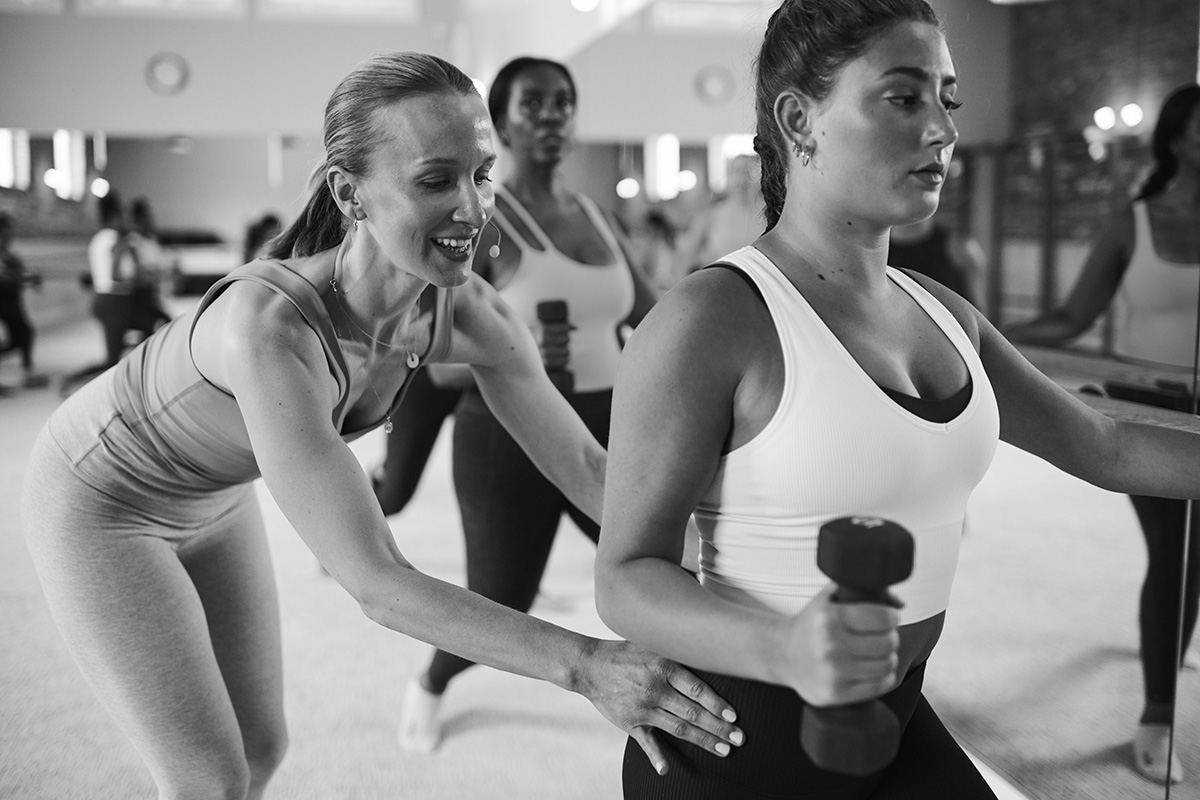
What’s more, it can easily be adapted to fit where you’re at in recovery. When you’re ready to start core workouts at home or attend classes again, instructors are trained in pre- and postnatal modifications and recommendations, ensuring exercises are adapted to protect the pelvic floor, back, and joints while promoting gradual strength and endurance.
When to start postnatal core exercises
Postpartum recovery timelines vary, and every individual’s journey back to exercise looks different. If you’re asking yourself, “How soon after birth can I do core exercises?” take a breath and be honest with yourself about how you’re feeling. Most importantly: Don’t return to exercise until you’re cleared by your OB. Once you’re cleared, it’s time to ease back in.
The American College of Obstetricians & Gynecologists’ position says returning to exercise should happen gradually, and that each person’s physical journey will look different, depending on their baby’s delivery. Rather than focusing on a specific timeframe, pay attention to how your body feels during and after workouts. Signs that indicate the body is adapting well and ready for gradual progression include:
- Steady energy
- Improved core control
- Improved pelvic floor control
- Ability to recover without increased soreness, pain, or fatigue
By listening to your body, honoring rest and recovery, and following appropriate postnatal modifications, you can safely rebuild strength, endurance, and confidence at a pace that is right for you.
The best barre exercises for postpartum recovery
Rebuilding strength after a baby doesn’t mean doing less — it means doing things differently. These exercises are specifically suited to the postnatal phase, with an emphasis on deep core activation, pelvic floor engagement, and controlled movement over intensity. Work through each of these postpartum core exercises mindfully, and let form be your guide for when to progress.
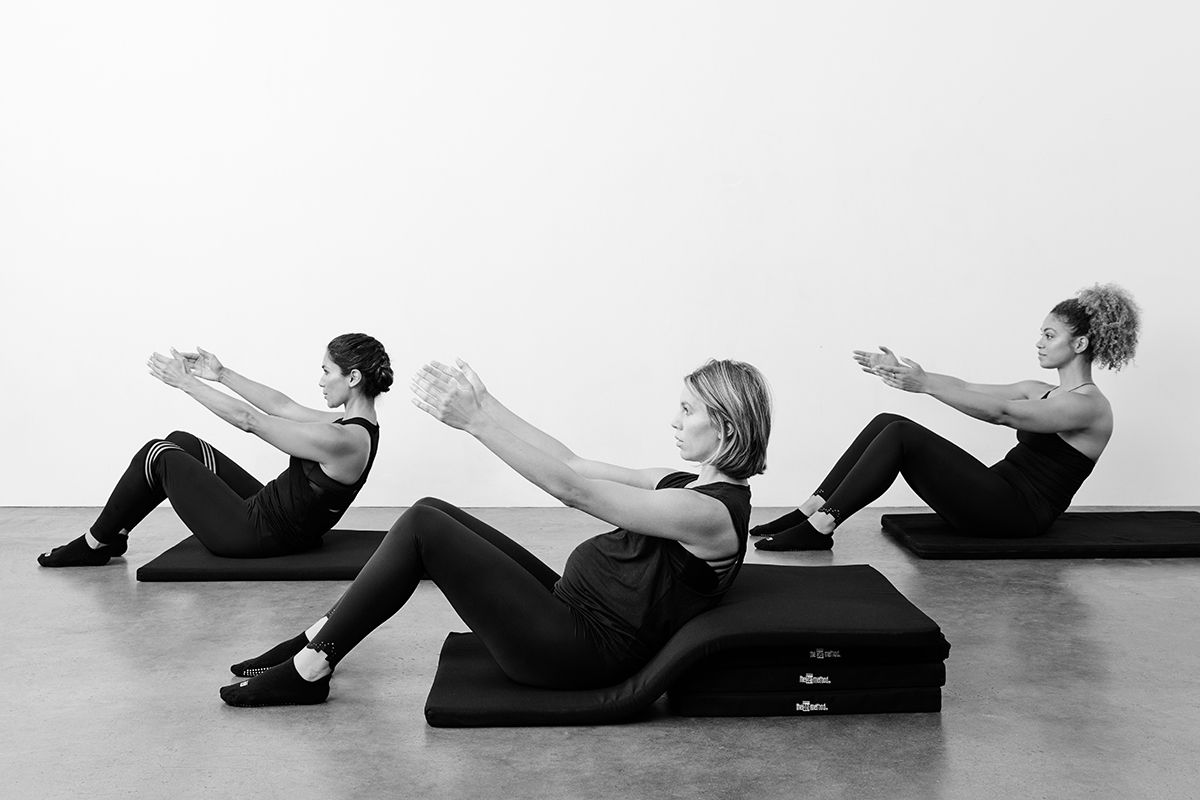
Flatback curl with heel taps
Curl work is one of the most effective postnatal core exercises — not because of how much you move, but because of how you engage. The goal is to strengthen your transverse abdominis. Breath and control take priority over range of motion.
How to:
- Lie down and place a small mat under your glutes.
- Extend your legs over your hips and keep them hip-width apart. Bend your knees to 90 degrees and flex your feet.
- Pull your abs in to secure your lower back and create a pelvic lift.
- Place your arms in a low “V” shape by your hips and push down into the floor for leverage.
- Slowly lower each leg a few inches forward, then slowly raise it back over your hip. Tip your thigh forward rather than straightening your knee.
- Keep your hips slightly tilted upward to maintain abdominal engagement and breathe deeply throughout.
- Perform up to three sets of 10 to 20 reps.
Back dancing
Seat work strengthens the glutes and lower back while gently reengaging the pelvic floor through small, controlled movement.
How to:
- Lie down on a comfortable surface with your legs bent and your feet flat on the floor. Slide your feet as wide as your hips and farther away from you so that they are more forward of your knees. For more challenge in your hamstrings, work with your knees less bent and/or flex your feet.
- Lift your seat up and down off of the floor 20 times, keeping your ribcage down to avoid your weight shifting into your upper back, shoulders, and neck.
- Hold your seat at the top of your range and squeeze your glutes 20 times.
- Repeat the circuit a few times until you’ve been moving for about 3 minutes.
Bent-elbow lifts
New parents lift, carry and hold their baby throughout the day. Light arm work rebuilds upper-body strength and supports posture in a low-impact, controlled way.
How to:
- Hold a pair of weights in each hand.
- Place your arms at a 90-degree angle and raise your elbows to shoulder height.
- Move your arms up an inch and down an inch at a time.
- Complete up to 5 sets of 8 reps at a time. Reset your elbows down to your waist between sets to allow your shoulders a moment to recover.
Final strap stretch
The stretch series promotes circulation, releases tension, and restores range of motion — with the added postnatal benefits of addressing the tightness that builds up from nursing, carrying your baby and sleeping positions.
How to:
- Lie on your back on the floor.
- Hold a strap in both hands and place the center of the strap across the bottom arches of your feet.
- While lying on your back, straighten your knees above your hips, keeping the strap in contact with your feet. Find a comfortable grip on your strap that allows you to relax your neck and shoulders while creating tension on your hamstrings.
- Lower one leg to the floor in front of you.
- Straighten both knees and flex both feet. Bend your elbows outward and gently pull your top leg closer to you.
- Breathe deeply and relax your hamstrings.
- Hold this position for about 10 seconds, then change sides.
How to progress postnatal barre workouts safely
Progress looks different postpartum — and that’s okay. The goal isn’t to pick up where you left off but to rebuild smarter. Here’s how:
- Start shorter and lighter. Begin with 30- or 45-minute workouts and incorporate bodyweight or light resistance before progressing to longer formats and heavier weights.
- Let form lead the way. Proper alignment, breath, and core engagement will tell you about readiness.
- Progress in small steps. A few reps without hands behind your head, a plank held a few counts longer — small wins add up.
- Modify without guilt. Props and adjustments aren’t limitations — they’re the tools that help you retrain correctly and avoid setbacks. If form breaks down, go back to what was working. It’s not a step backward — it’s just where your body is today.
- Rest is work. Recovery between workouts matters as much as the workouts themselves.
FAQs new moms often have about postpartum exercise
What is the 5-5-5 rule postpartum?
The 5-5-5 rule is a postpartum rest framework — five days in bed, five days on the bed, five days around the bed. It’s designed to encourage new mothers to prioritize recovery in the first two weeks after birth. It’s not a clinical guideline, but a reminder that rest is just as important as movement in early recovery.
How do I heal my abdominal muscles after pregnancy?
To address abdominal separation, engage in exercises and postures to promote breath work and recruit the deep abdominal muscles. The focus should be on the transverse abdominis through controlled breathing, gentle engagement and supported movement rather than traditional exercises like crunches or sit-ups.
How long does it take for your core to recover after birth?
It varies for each person. The postpartum period is generally considered the first 12 weeks after delivery, although the symptoms and changes that occur can extend the timeframe for some. Core recovery depends on the degree of muscle separation, pelvic floor function, consistency with appropriate exercise, and individual healing timelines.
Can I do crunches two months postpartum?
The right approach depends on your individual recovery, whether you have diastasis recti, and how your deep core muscles are functioning. When in doubt, consult your healthcare provider or a pelvic floor physical therapist before reintroducing traditional ab exercises.
Rebuild from the inside out with barre
Every postpartum journey is different — but the desire to feel strong again is universal. While barre is challenging by nature, its exercises can meet you where you are and adapt as you rebuild core strength with the specialized attention it needs before returning to “business as usual.”
Whether you’re working through diastasis recti, rebuilding pelvic floor function or simply trying to feel like yourself again, these postnatal core exercises will help you get there.
More core and pregnancy workout tips from The Bar Method
- Barre During Pregnancy: Why It’s a Safe and Effective Workout
- Transverse Abdominis Workout to Target Your Deepest Core Muscles
- How to Practice Mindfulness During Barre Class
Ready to take the first step? Find a Bar Method studio near you and let our instructors — trained in postnatal-friendly adaptations — guide you.