New clients! For a limited time, Get 13 Classes for $78 (only $6 per class)

The Method
How to Set Fitness Goals for Strength and Longevity
May 12, 2026
From signing up for a workout class you’ve never done before (like barre!) to training for your first 10k, setting fitness goals can be the key to taking your exercise routine to the next level. Striving for new benchmarks adds an element of challenge — and while this can fuel motivation, it’s also possible to push yourself too far. No one wants to get injured or sidelined with an injury, and choosing the right goal can make all the difference in your exercise journey.
That’s where we come in! In this article, we’ll walk you through how to set fitness goals that support you, and how to achieve your fitness goals from start to finish with proper recovery. We’ll also share healthy tips for encouraging yourself with grace and self love as you grow in your fitness journey.
We’ll cover:
- How to get started (before even setting fitness goals)
- Setting sustainable goals for working out that serve you long term
- 3 types of fitness goals to consider
- Tips for success — how to maintain strength and show up week after week
Before setting new fitness goals, do this…
Before setting new goals for working out, take some time to reflect. What type of plan has worked for you in the past? Was there a time when your workout plan didn’t pan out — and if so, why? How can your fitness goal align with what is most important to you?
When it comes to your health and approach to fitness and physical activity, your priorities are likely multi-faceted, bridging challenge and safety so you can see results, and also keep doing the workout you love for years to come.
In addition to a physical challenge, you might value variety (like different class options for different days), motivating, supportive community, or a workout that’s sustainable for your body — hint: barre’s low-impact, high-intensity format may be your perfect match! By identifying what’s most important to you in a workout plan, you can keep it aligned with your core interests, and make adjustments as these evolve.
Once you’re clear on what aspects of a workout you want to include in your next goal, identify your “why.” Your “why” or your intention, can be simple. It’s the reason you pursue fitness goals in the first place, and one you can come back to again and again as you grow in your fitness journey.
What are good fitness goals that include an emphasis on recovery?
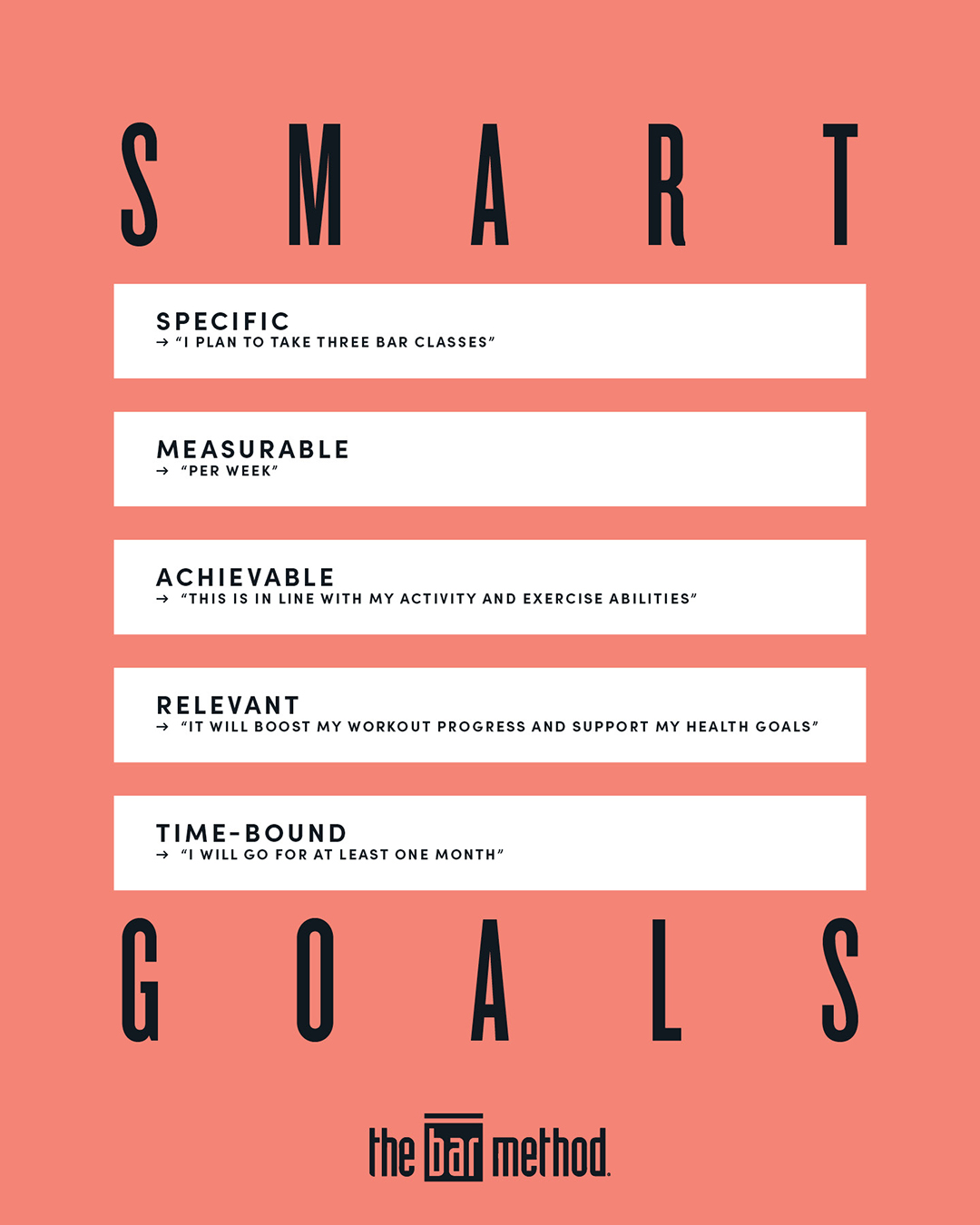
If your goal includes both physical challenge and a restorative focus, first map out all the tiny pieces you need to succeed — take a look at everything from your schedule to your health to your diet. Next, apply the S.M.A.R.T. goal formula. This format offers five helpful guidelines for setting fitness goals so that you can make them:
- Specific
- Measurable
- Achievable
- Relevant
- Time-bound
Here’s an example of a S.M.A.R.T. goal: “I plan to take three barre classes per week, for one month. This is in line with my activity and exercise abilities, and will boost my workout progress and support my health goals.”
Notice that this goal offers challenge and requires commitment while fitting within a healthy framework that includes room for recovery. This allows the goal-setter to keep showing up week after week for safe, sustainable progress.
Let’s look at each component:
How to set fitness goals for progress, strength, and holistic wellbeing
Different types of fitness goals work for different people, and your last fitness goal could be wildly different from the one you’re about to set now. It all comes down to your personal journey, health, and physical abilities. As you set goals for working out, use the three categories below as a guide to setting goals that challenge you while also taking self care and longevity into account. (Note: This may include caring for a previous injury, or taking extra measures to build and maintain your body’s functional strength well into the future.)
Progress: Fitness goals for reaching your next personal best
If you’ve routinely reached fitness goals in the past, deciding how to set fitness goals may be second-nature. Perhaps you’re looking for your next big workout challenge, and the self improvement that comes as you progress further on the journey. If this sounds like you, here are a few example goals to help you get started:
- Take more barre classes in one month than you ever have before (e.g., 10, 15, 20, etc.) while integrating restore classes to help your body feel its best.
- Practice a challenging barre posture daily for a certain length of time, so that you can hold it longer than you have before.
- Commit to spending extra time on recovery practices each week to help you push further during class. (Keep in mind that some goals can be about setting up the right conditions for your success!)
Strengthen: Fitness goals for strength, toning, and weight loss
If you’re considering a fitness goal that focuses on your body and what it can do, remember that your body is already amazing as you work toward the next step. Plus, your efforts can be satisfying each step of the journey, not just once you achieve your goal. Looking at physical activity as a form of self love or as a self care practice can help you challenge yourself and progress while benefiting your overall health and mindset. With that in mind, here are a few example goals that can impact your body and health through strength, toning, and weight loss:
- Boost mental and physical endurance: Choose the challenge options in barre class to boost mental and physical strength.
- Toning and sculpting: Practice barre exercises (like these) at home several days per week, designed to sculpt your body between workout classes.
- Weight loss: Take your favorite barre classes consistently, which have high-intensity and lower-intensity intervals for calorie burn.

Feel amazing: Fitness goals for long term, holistic wellbeing and energy
If your goal is to feel healthy, energized, and confident, focus on consistency. Rather than challenging yourself to the max, your mindset can be about progress over perfection, stepping out of your comfort zone, and committing to a realistic schedule that works for you. Practicing exercise modifications that support your body and needs can help you get there. Here are few example goals to help you get started:
- Try a few different Bar Method class formats (or all!) to decide what works best for you, and invite variety into your day-to-day routine.
- Say hello to your workout class instructor or another class attendee at each class to expand your community and get answers to possible questions.
- Take a fitness class or move your body first thing in the morning to start your day on the right foot with an energy boost.
Smart tips to help you track progress
Depending on your S.M.A.R.T. goal, you may have a short- or long-term fitness goal.
Examples:
- Short-term fitness goal: Enhance push-up form and perform 30 consecutive push-ups (a serratus anterior exercise)
- Long-term fitness goal: Enhance push-up form by practicing push-ups every week for one year
Both of these types of goals can be tracked in a notebook or in your smartphone. You can also keep track of the days you work toward your goal using a paper calendar by marking an “X” for each day you make progress. Over time, you’ll be able to see the work you’ve put in, which will help you stay motivated and give yourself grace even if you skip a day or two, or even a few.
Your progress can be measured and documented by how often you work toward your goal, with details such as how much time you spent or how many reps you performed, which will vary based on your goal. But your progress can also be measured holistically, such as when you notice post-workout soreness and feel the results of your hard work, or when your functional strength allows you to perform tasks you couldn’t before.
How to achieve your fitness goals while listening to your body’s needs — and limits
Once you have a clear fitness goal determined and have included the five S.M.A.R.T. goal components, you’ll be ready to get started on your goal. To maintain the strength you build through your barre schedule or preferred workout routine, listening to your body is essential. This is a daily practice — after every workout, exercise class, morning, and night, pay attention to its signals and give yourself grace if you need time to recover (you’re human!). Taking a rest day or week (or even longer if needed) can be exactly what you need to avoid injury and keep showing up for your workout.
Even the most challenging fitness goals can be achieved with commitment and support. This is where friends, families, and your community come into play: Let someone know about your goal and ask them to support you along the way. That could mean checking in with you about how your progress is going or joining you for a barre class. Health and wellness can be personal, so if you prefer to work toward your goal on your own, tracking your own progress can also be a way to practice self love, remind yourself how strong you are, and help you reach it.
A final word on how to set fitness goals
Now that we’ve covered how to set fitness goals that help you level up safely and sustainably, the next step is to get started! Start exploring which workouts excite you most and as you jump in, keep in mind that our barre community is here to support you as you achieve every single one of your goals for working out. You’ve got this!
Let’s make your next fitness goal a reality with a full-body, low-impact workout you’ll love! Find your studio now.